
Key points:
- Following a holiday freeze, job seeker searches and applications soared at the start of 2026, rising to 19% and 10% above their levels in late November, respectively, a similar seasonal pattern to 2025.
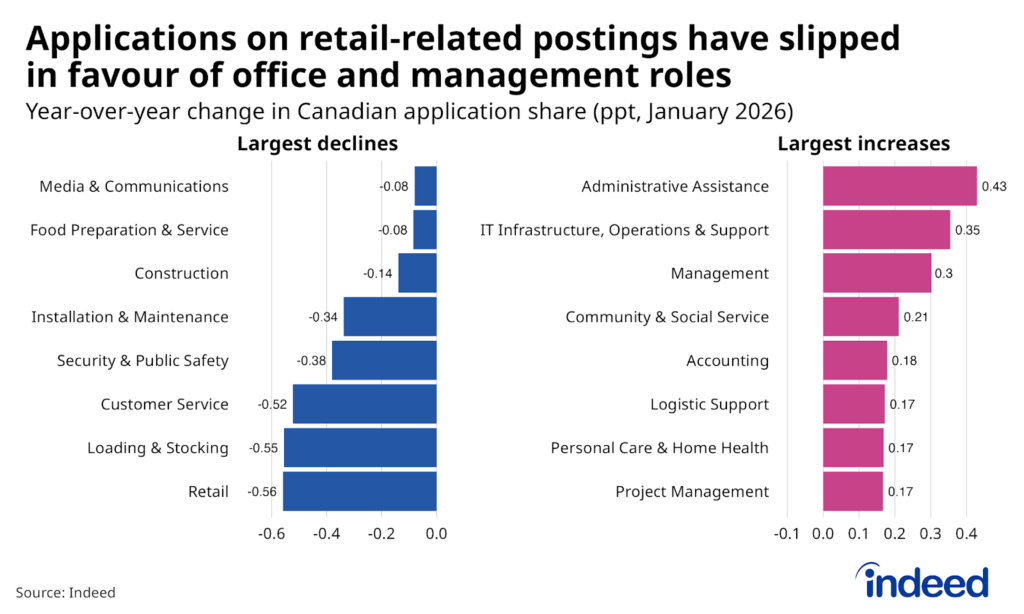
- The share of Canadian job applications in January 2026 going to job postings in security and retail-related fields, including loading and stocking and customer service, fell two percentage points from a year earlier, while the share of applications going to roles in administrative assistance and management rose.
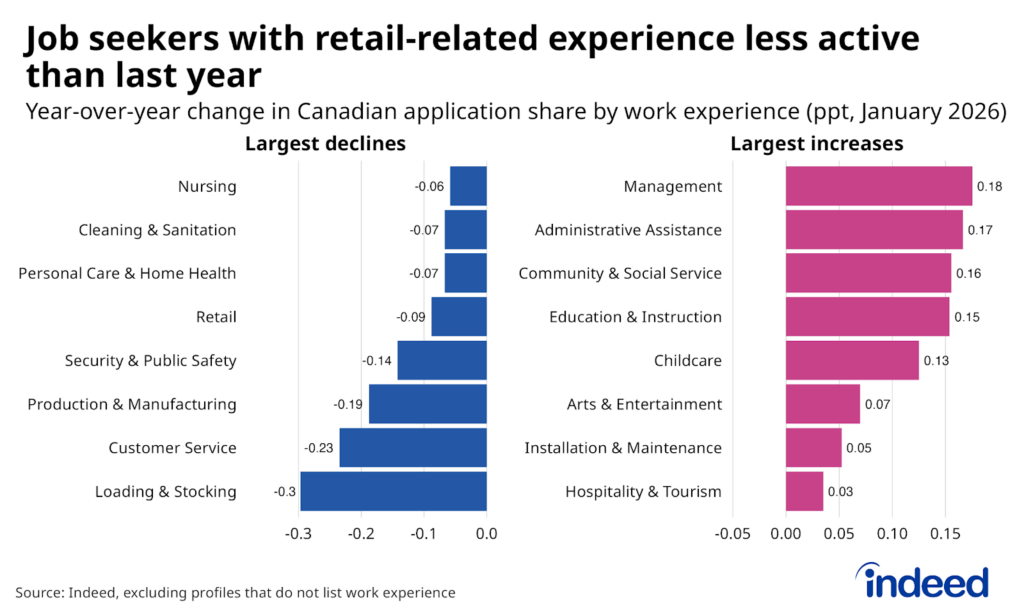
- These shifts in applications were partly driven by similar changes in the work experience of active job seekers, which may reflect falling numbers of non-permanent residents in Canada.
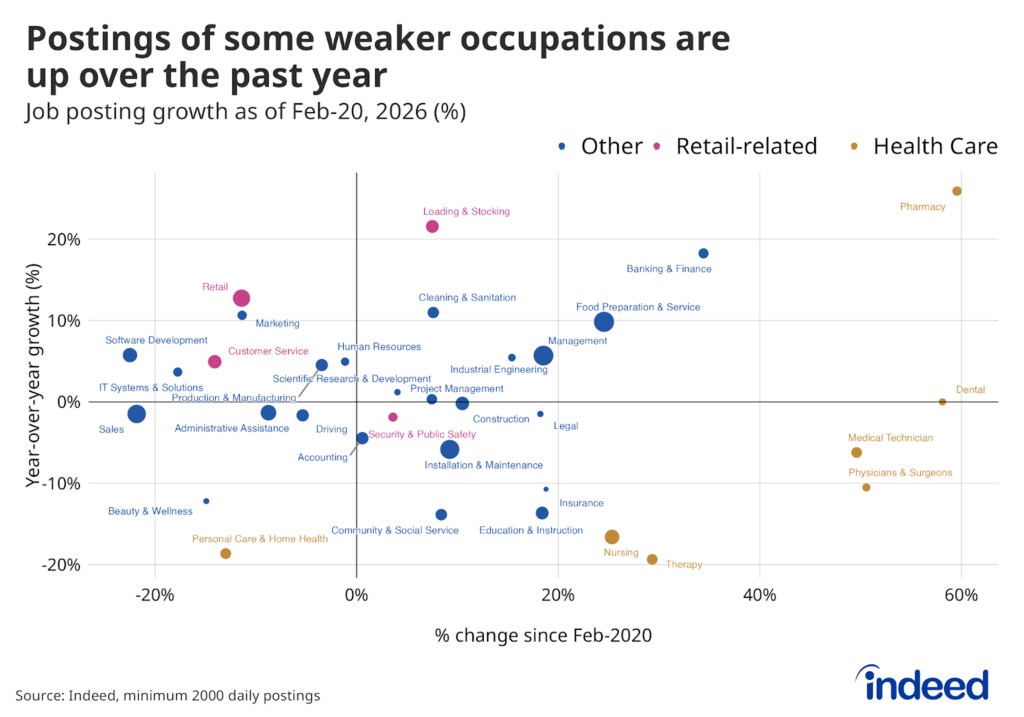
- Canadian job seekers in early 2026 are facing a soft but stable job market: Job postings on Indeed in mid-February were flat from a year earlier, reflecting an uptick in lagging sectors like retail and tech, and softening of demand in still-elevated health care and education.
Job seeker activity is highly seasonal. Every November, Canadian searches and applications on Indeed start declining, bottoming out around Christmas. But not long after the clock strikes midnight on New Year’s, activity roars back – a pattern that occurs across economies with such regularity that we have a name for it: the “January Jump.”
Once again, search activity is jumping to start the year. Canadian job searches and applications slid towards the end of 2025 – by the week of December 27, searches and applications stood 38% and 43% below their late-November averages, respectively. These declines were broadly similar to those in late 2024. However, applications (but not searches) fell somewhat faster during the first half of December 2025 (-18%) compared to December 2024 (-10%), before re-converging at their low point over the holidays.
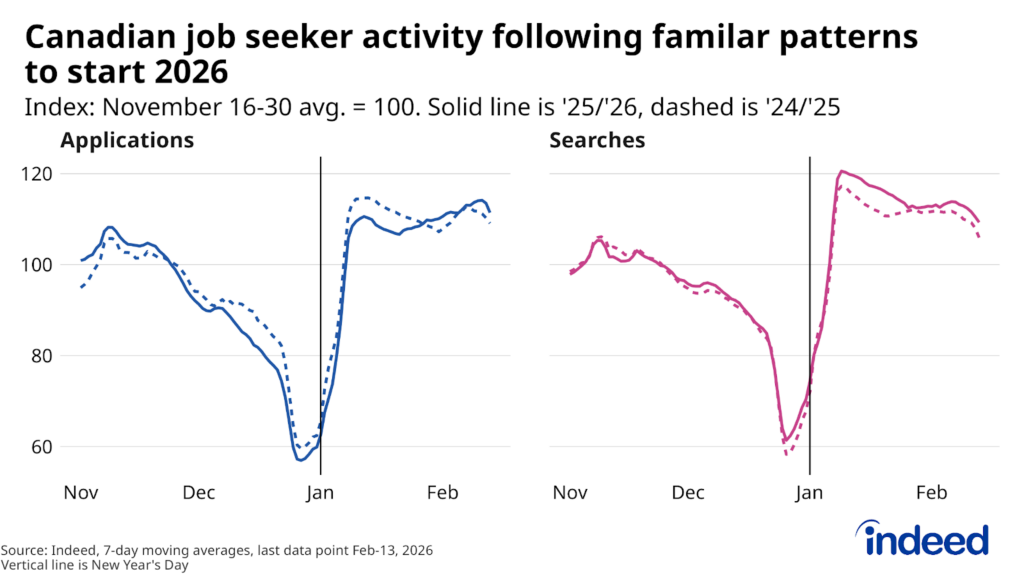
By early 2026, the January Jump was in full effect: Job applications between January 7 and 14 were nearly double their late-December levels and were 10% higher than in the second half of November, a level they maintained through mid-February. Searches spiked even more, standing 19% above their late-November level in early January, before cooling off somewhat. The initial jump in applications wasn’t quite as sharp as in early January 2025, but searches were up slightly more, and the overall seasonal patterns were similar to last year. Clearly, after a brief pause at the end of 2025, Canadian job seekers are back on the hunt.
Job seeker interest has shifted away from security and retail-related roles
While aggregate application trends are showing familiar seasonal patterns, there have been shifts in the types of jobs Canadians are looking for to start 2026. In particular, interest in a range of retail-related occupations, as well as in security and public safety (which partially overlaps with the retail sector), has dropped. Together, the share of applications on postings for roles in retail, loading and stocking, customer service, and security and public safety fell to 17.5% in January 2026 from 19.5% in January 2025. Conversely, job seeker interest rose for several office-related roles, including administrative assistance, IT operations, accounting and management.
One reason interest in retail and related positions fell was that job seekers with recent experience in these fields (based on their work history reflected in their Indeed profiles) were less active this year than a year earlier. In January 2025, almost one-in-five (19.6%) applicants to retail or retail-adjacent jobs had recent work experience in retail, customer service, loading & stoking and/or public safety. By January 2026, that had fallen to 18.9%. Job seekers with manufacturing backgrounds were also less active, potentially due to ongoing trade uncertainty in the industry. Conversely, job seekers with experience in management, administration, and community service were relatively more active. Since job seekers apply to postings in their current field at higher rates than other workers, shifts in who is actively seeking work influence application trends within each sector.
The recent whiplash in Canadian immigration policy could also be influencing both the drop in the share of applications to retail-related roles and the associated shift in the mix of job seekers. In earlier analysis, we found that job postings in retail, loading & stocking, and security & public protection were among the sectors that experienced the sharpest increases, and subsequent decreases, in job seeker interest from abroad between 2021 and 2024. Rising outflows of non-permanent residents from Canada over the past year are potentially driving further shifts in job seeker activity.
The early 2026 job market is soft, but stable
Canada’s low-hire, low-fire labour market of the past few years has been challenging for job seekers across a range of circumstances. While there aren’t signs of a solid imminent improvement, the situation has stabilized. As of February 20, 2026, Canadian job postings on Indeed were flat from a year earlier, standing slightly above (+3%) their pre-pandemic level.
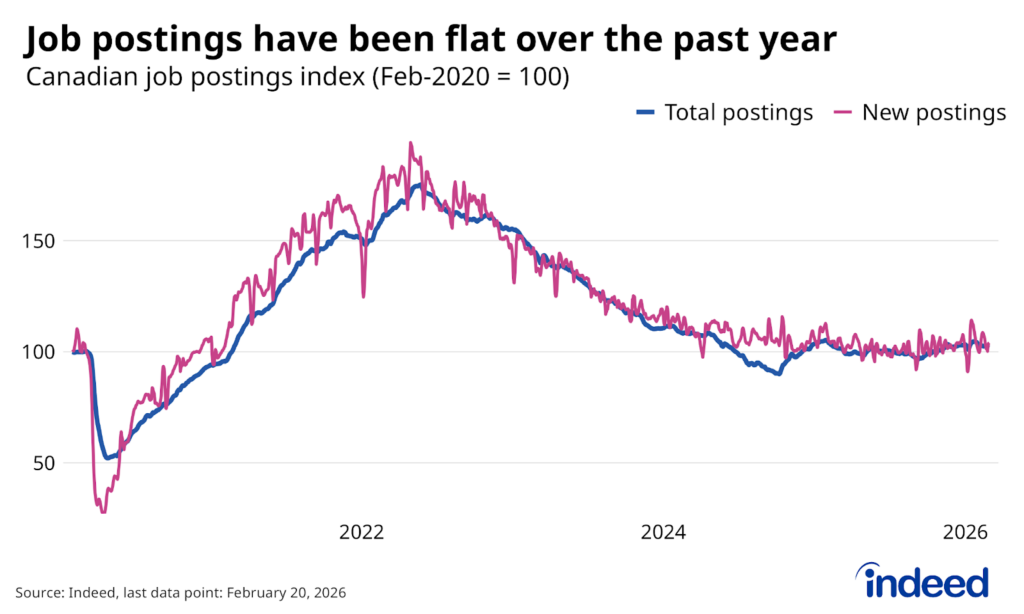
Recent posting trends have been mixed across sectors. Postings have edged up over the past year in several sectors where overall demand remains subdued compared to early 2020, including areas that have lost job seeker interest, such as retail and customer service, as well as tech fields, including software development and IT systems & solutions. Meanwhile, job ads slipped year over year in health care and education, though demand in these areas remains relatively strong over a longer horizon.
Job seekers might be back on the hunt to start 2026, but as the prior year shows, the “January Jump” alone won’t be enough to kick-start a return to a more fluid labour market. Rather, we’ll need to see a more robust economic situation – likely beyond the median forecast of 1.6% for GDP growth in 2026 – to turn the situation around. In the meantime, the 2026 labour market will be defined by how the somewhat static dynamics of recent years interact with faster-moving trends related to trade, immigration, artificial intelligence, and now, geopolitical uncertainty.
Methodology
All job postings figures in this blog post are the index of seasonally adjusted Canadian job postings on Indeed, rebased to February 1, 2020, using a seven-day trailing average.
The number of job postings on Indeed, whether related to paid or unpaid job solicitations, is not indicative of potential revenue or earnings of Indeed, which comprises a significant percentage of the HR Technology segment of its parent company, Recruit Holdings Co., Ltd. Job posting numbers are provided for information purposes only and should not be viewed as an indicator of performance of Indeed or Recruit. Please refer to the Recruit Holdings investor relations website and regulatory filings in Japan for more detailed information on revenue generation by Recruit’s HR Technology segment.